Mould claims on toy shipments are usually argued as manufacturing defects and are usually caused by container humidity. A sealed container carrying cartons packed in humid conditions, or loaded in the rain, traps moisture that condenses on the container walls during the voyage and settles onto whatever is nearest. Plush, paperboard and wooden items absorb it; by arrival the goods show spotting that looks like a production fault but is a transit condition.
That is a transit problem and a documentation problem at once, which is why our toy importer solutions page treats evidence and prevention as one subject rather than two.
Key takeaways
Mould claims on toy shipments are usually argued as manufacturing defects and are usually caused by container humidity.
Paperboard packaging is next, because it wicks moisture and shows it as warping and spotting.
Where the order is large enough to justify it, a moisture check on the packed cartons before loading settles the question in advance.
The cost lands on whoever is unable to prove where the moisture entered, which is why prevention and evidence both matter. Neither is expensive.
Which Products Are at Risk
Risk is concentrated in hygroscopic materials – those that absorb and hold moisture from the air. Plush and fabric items are the highest risk because they hold moisture and show staining quickly. Paperboard packaging is next, because it wicks moisture and shows it as warping and spotting. Wooden items follow, particularly unsealed surfaces.
Plush and fabric – absorbs moisture, shows spotting within days in a humid container.
Paperboard and printed cartons – wicks moisture, warps and shows tide marks.
Wooden items – unsealed or thinly finished surfaces swell and discolour.
Low risk – sealed plastics, which is why most mould claims involve mixed loads.
Prevention at Origin
Prevention starts with the moisture content of the goods at packing. Cartons packed in humid conditions carry that moisture inside, and no amount of desiccant fully compensates. The practical measures are packing in dry conditions, using moisture-barrier packaging for high-risk items, and including desiccant in the container proportional to its volume.
The desiccant quantity is not a guess – suppliers calculate it from container volume and voyage conditions, and a specification that states the quantity is far more likely to be followed than one that says “adequate desiccant”. Loading in dry weather, or covering the load during rain, is the other half of the control.
Evidence at Destination
When mould is found at arrival, the evidence that matters is the container’s condition on opening: wall condensation, wet carton exteriors, and photographs taken before unloading. An importer who photographs the container interior on opening can usually show that the moisture arrived with the shipment rather than originating in the goods.
The counter-argument is that the goods were packed wet, and the answer to it is a moisture reading at origin. Where the order is large enough to justify it, a moisture check on the packed cartons before loading settles the question in advance.
Loading and Stowage
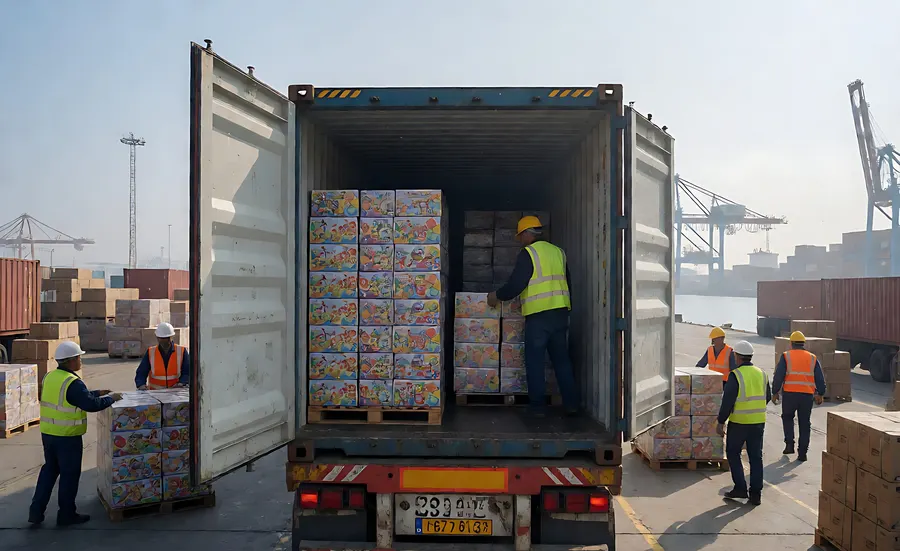
How the container is loaded affects condensation as much as what is in it. Loads stowed tight against the walls condense onto the wall and transfer to the cartons; loads with a small air gap and proper dunnage dry more evenly. Palletised loads with stretch wrap also trap less moisture than loose-stowed cartons.
One further control is the drying step itself. Where goods have been exposed to humid conditions before packing, a short drying period or a dry-store hold before cartoning removes moisture that desiccant then does not have to absorb. The humidity of the packing room is the variable most easily overlooked and most easily corrected.
It is also worth agreeing the inspection point at destination in advance. A container opened and inspected at the terminal, with photographs taken before unloading, produces evidence; a container unloaded first and inspected later produces an argument about when the moisture appeared.
Route matters as well. Voyages through tropical loading ports in the wet season carry more risk than the same route in the dry season, and a specification that ignores season is a specification that works for part of the year. Where a route is seasonal, the desiccant quantity should vary with it rather than staying fixed.
One more practical measure: instruct the loading crew. Cartons loaded in rain, or stowed against container walls, create the condensation pattern that follows, and a one-page loading instruction issued with the booking is cheaper than any of the packaging measures that follow. The containerization process itself is where most of the control sits.
A final note on record-keeping: keep the desiccant specification, the packing condition and the arrival inspection together per shipment. When a claim arises two months later, those three records are the whole case, and they are much easier to keep than to reconstruct.
One last item for the specification itself: state the moisture barrier requirement per material type rather than as a general instruction. A specification that names which items need barrier packaging and which do not is a specification a packing crew can follow without interpretation.
It is also worth photographing the load as stowed. A single image of the finished load, showing the air gap and the dunnage, is useful evidence if a claim arises and costs nothing to capture at the time.
No. It manages humidity, but goods packed wet arrive wet regardless. Prevention is packing dry plus desiccant plus barrier packaging for high-risk items.
How much desiccant should a container have?
It is calculated from container volume and voyage conditions. Specify a quantity in the order rather than asking for “adequate” protection.
Which products need barrier packaging?
Plush, fabric, paperboard-heavy items and unsealed wood. Sealed plastics generally do not need it.
What evidence proves transit moisture?
Photographs of container wall condensation and wet carton exteriors taken before unloading, plus the arrival inspection record.
Can mould be cleaned off toys?
On hard surfaces sometimes; on fabric and paperboard usually not to a saleable standard, which is why prevention is the only real answer.
Does voyage length matter?
Yes. Longer voyages give condensation more time to form and settle, so long routes need more protection, not the same.
Should I test moisture content at origin?
For large or high-risk orders yes. A reading on packed cartons before loading settles the origin-versus-transit argument in advance.
OEM & ODM TOY MANUFACTURING
Ready to Develop Your Custom Toy Line?
10+ years factory experience • EN71, ASTM F963 & CPC compliance support • Flexible MOQ for toy brands, importers, and Amazon sellers.