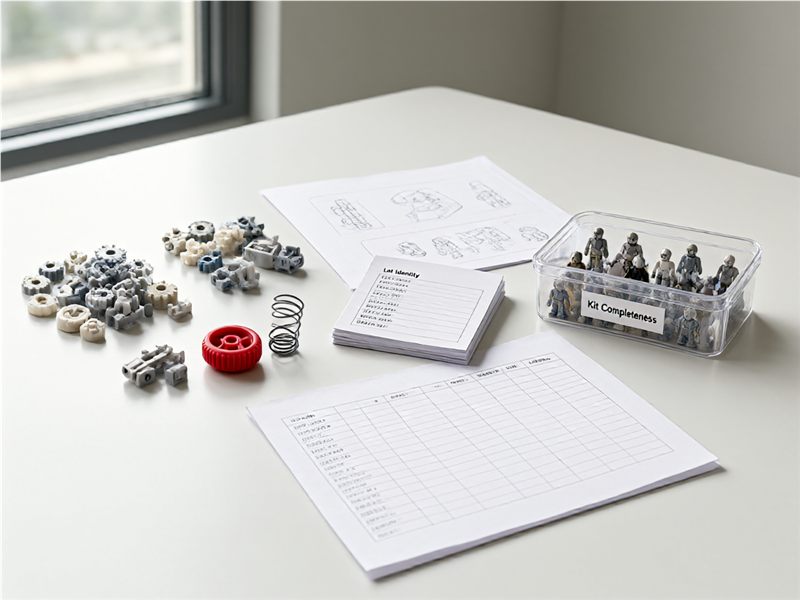
At 09:12 on a Tuesday, the complaints log took an entry that looked routine: a wholesaler had opened a carton of assorted slime kits and found one pack without its mixing spatula. Not a damaged spatula, not a broken seal — one component simply absent from a kit that should have held a tub, a sachet, a stirrer and a printed instruction card. The carton had arrived taped and apparently intact, so the first assumption in the warehouse office was that the pack had left the line short. That assumption is precisely what a trace exists to test. What follows is the file as it was rebuilt, working backwards from the complaint to the moment the components were issued to the line.
The complaint as a piece of evidence, not a conclusion
A missing-part complaint is an opening statement, not a finding. Before anyone reaches for a pick list, the log entry itself has to be made usable: which SKU and configuration, which carton and which lot code, which component is missing, how many packs in the carton were checked, whether the others were complete, whether the tape looked original, and what the opening photographs show. An entry that says only “spatula missing” cannot be investigated, because it does not say where to look.
Three different failures can produce the same sentence. A whole carton short of stirrers points to issuing or kit assembly. A single pack short of one stirrer points to the packing station. A component that was present but hidden in the filler or mistaken for packaging points to the instruction card or the pack layout. Each conclusion demands a different correction, so the first job of the log is to separate them by describing the carton, not just the missing piece.
Anchoring the complaint to a lot code rather than a date
“The batch we shipped last week” is not a locatable object in a warehouse. Several lots of the same kit can sit in despatch in the same month, a reworked lot may have been folded back into stock, and a replacement part sent separately will carry its own movement record. The complaint has to be pinned to the carton mark or the lot code printed on the pack, ideally with a photograph, because that code is the join between the finished-goods record and every document upstream of it.
Once the code is fixed, the chain of documents becomes finite: the finished-goods put-away note, the packing list for that carton, the component issue note for that lot, and the incoming lots of the parts themselves. Without it, the investigation degrades into recollection. The configuration behind the code matters too — the bill of materials and the pack-out list define what “complete” means for this SKU, which is why a controlled specification is the reference a trace is measured against. Our page on product data sheets, variants and packaging sets out how that configuration should be recorded so a complaint can be tied to a defined kit rather than to a verbal understanding of it.
Reading the pick list backwards
The component issue note, or pick list, is where the trace becomes arithmetic. For each production lot it should state which components were withdrawn, in what quantity, against which kit configuration, who picked them, who issued them, and who signed. The first backward step is to pull the note for the complaint lot and compare the quantities issued with the number of finished kits booked into stock.
Two habits muddy that comparison. Components are often issued in bulk packs rather than counted per kit — a bag of stirrers whose count does not divide neatly into the kit quantity — and top-up issues during a rush are sometimes taken without a separate note. Both are normal on a busy line and both make a clean reconciliation impossible after the fact. The question to put to the document is narrow: for this lot, can the number of each component issued be accounted for by finished kits, documented returns, and recorded scrap? If any of those three terms is missing, the gap is in the records, not necessarily in the box.
The return-to-stock note nobody filed
Surplus components are the quiet corrupter of a completeness trace. When a line draws more than it uses — a colour change, a shortened run, a rejected batch of one part — the remainder should go back to stores with a return-to-stock note recording the quantity, the lot and the condition of the parts. When that note is not written, the material is physically somewhere in the building while the ledger still shows it as consumed by the job. A later count then cannot distinguish “issued to this lot” from “issued to this lot and partly used elsewhere”.
In this complaint, the absence of a return note would explain a ledger that balances while a carton does not. The check is a three-way comparison: issue note quantity, finished-goods quantity, and return note quantity, each tied to the same lot code. Returned parts also need a status — sealed and reusable, opened, or quarantined — because a component that has been opened and set aside on a shelf is not the same asset as one in its original packing. How that material is identified, segregated and stored while it waits is covered in our note on warehouse storage and humidity control; an unlabelled box of returns defeats the trace as surely as no note at all.
Where a substitute part is allowed to enter the record
A kit is rarely assembled from one unchanging set of parts. A component runs short, a supplier changes a specification, or a buyer approves a different colour or material, and a substitute is used. That decision should leave a dated approval naming the part, the lots it applies from, and the person who authorised it. During a trace, the question is whether the complaint lot falls inside that approval window, and whether the substitute changed anything about how the kit is counted or packed.
Substitution touches completeness more often than people expect. A thinner stirrer, a sachet in a different wrapper, or a card printed on lighter stock can change what a packer feels, what a weight check reads, and what a customer believes belongs in the box. If the approval record was never linked to the pack-out list or the instruction card, the same kit now has two definitions of “complete”: the one the line worked to and the one the wholesaler is holding.
Counting at every handover, and where the count breaks
Between the stores and the sealed carton, a kit passes several handovers: components issued, kits assembled, units bagged, inner packs built, outer cartons filled, cartons closed. At each point someone counts something, but the strength of the evidence varies sharply. The issue note is a signed document. The assembly count may be a tally on a board. The final step is often a count of cartons, not of the kits inside them. A trace has to identify the last point at which anyone could still prove, from a record, that this specific pack held all its components.
The break almost always occurs where the unit of counting changes from pieces to boxes. Once a team is counting cartons for despatch, no one is verifying the contents of each individual kit, and completeness becomes an assumption inherited from an earlier station. That is why a single-pack shortage tends to point back to assembly or inner-pack building rather than to the raw-material store, even though the complaint arrives as a warehouse problem.
The carton weight check as a proxy, not proof
A weighed carton can flag a shortage cheaply, and many pack-out lines keep a weight record for exactly that reason. It is a proxy, though, not a demonstration of completeness. Light components sit inside a wide tolerance; filler, printed cards and film vary between lots; a missing stirrer may fall inside the same range as a heavier sachet from a different incoming batch. A weight log is only as good as the threshold it was set against and the rule for what happens when a carton falls outside it.
Used correctly, the record narrows the investigation rather than closing it. If the complaint carton weighed in line with its neighbours and the tape was original, the shortage is less likely to have originated on the line. If it was light, with the seal intact, the packing station becomes the place to look. Either way the weight entry has to be traceable to the carton mark and to the person who cleared it, otherwise it is just a number with no box attached.
A trace sheet filled in from documents, not memory
The working sheet below is the one used to keep the investigation honest. Every row names a document that ought to exist, and the finding column is filled only from that document or from a stated absence of it. Nothing in it is an inference until the last two rows, where the inferences are labelled as such.
Trace step
Document that should exist
Finding recorded here
Who can confirm it
What it rules in or out
Complaint intake
Log entry with carton photo and lot code
Lot code captured; other packs in carton reported complete
Customer service lead
Narrows a whole-carton versus single-pack failure
Finished-goods put-away
Put-away note for the lot
Quantity booked against the same lot code
Warehouse supervisor
Anchors the population being investigated
Component issue
Signed pick list for the lot
Issued quantity per component recorded
Stores issuer
Tests whether books can be reconciled before inspecting cartons
Surplus return
Return-to-stock note with part status
Return documented or absent
Stores receiver
Explains a ledger that balances while physical stock does not
Substitute approval
Dated authorisation naming effective lots
Whether this lot falls inside the window
Quality or buyer signatory
Rules a version mismatch in or out
Assembly and bagging
Station tally or count record
Last point where kit content was checked
Line supervisor
Locates the handover where counting changed to boxes
Carton close
Seal and weight record tied to carton mark
Weight relative to neighbouring cartons
Pack-out checker
Indicates line-origin or post-factory shortage
Despatch
Carton mark and packing list
Carton identity matches the complaint
Despatch clerk
Confirms the correct lot is under review
What the trace proved, and what it could not
Set the boundary of the conclusion deliberately. A reconciled pick list, a normal weight record and an intact seal support a narrow statement: on the documents available, no shortage was recorded before the carton closed. They do not prove the customer was mistaken. Records can be complete and still miss a single pack, and a light component can vanish inside a weight tolerance. Overstating a clean file as proof is how a second complaint becomes an argument about the first investigation rather than about the product.
The downstream leg is largely outside a factory trace. A carton can be opened and retaped, a wholesaler may split or recombine cartons during picking, and a replacement part sent earlier can be confused with the original pack. Those steps belong to the commercial handling of the claim, not to the component ledger. Our note on returns and damages handling for wholesalers covers how such claims are settled and recorded so the outcome does not quietly rewrite the factory finding. Keeping the two files separate is what lets both be audited later.
Closing the complaint with a correction, not a guess
Closure has three possible shapes and the evidence should choose among them. If the documents point to a line-origin shortage, the correction is a replacement part plus a change at the station where counting broke. If the customer misread the pack layout, the fix is a clearer instruction card or pack-out list. If the evidence is genuinely inconclusive, say so: a replacement may still be sent as a commercial gesture, but the file should record the finding as undetermined rather than as factory fault, because an undetermined finding is what justifies the process change that follows.
Write down which documents were examined, what each showed, how strong the resulting conclusion actually is, who authorised any replacement, and whether the bill of materials or pack-out list needs a new revision. Without that closing note, the same trace is rebuilt from memory six weeks later, and the second investigation will reach a different answer from the same facts.
The kit-completeness controls one complaint should leave behind
A single missing stirrer is cheap to replace; the value of the trace is the control it leaves behind. The obvious items are a versioned bill of materials tied to each lot, a pack-out list that matches the approved kit configuration, a second-person check or simple counting jig at assembly, a documented weight threshold with an exception rule, and one unopened retention kit per lot. Each one puts a signature or a measurement at a handover that previously had neither.
The less obvious item is the return-to-stock note, because it is the record most often skipped and the one that most often explains a ledger that looks clean. Completeness is not secured by checking a few finished kits at final inspection; it is secured when every handover leaves a document that can be read backwards. When a complaint arrives, that chain is the difference between a two-hour reconstruction and a week of people describing what they remember doing.
What should a missing-part complaint record before any investigation starts?
Capture the SKU and configuration, the carton mark or lot code, which component is missing, how many packs in that carton were checked and whether the others were complete, whether the tape looked original, and photographs of the opened carton, inner pack and neighbouring units. Without those fields the complaint cannot be located to a lot, and a whole-carton shortage, a single-pack assembly error and a customer misreading of the pack layout cannot be told apart.
Why is a lot code more reliable than a ship date for tracing a short kit?
Several lots of one kit can leave in the same week, reworked stock may be folded back in, and a separately sent replacement part carries its own movement record. A date points at a period, not an object. The lot code printed on the carton mark joins the finished-goods put-away note, the packing list, the component issue note and the incoming part lots, so the document chain becomes finite and comparable.
How does an unrecorded surplus return distort a kit completeness check?
When a line draws more components than it uses and the remainder is returned without a note, the ledger shows that material as consumed by the job while it physically sits elsewhere. Reconciliation then compares issued quantity against finished kits and finds an unexplained gap, or appears balanced while a carton is short. Require each return-to-stock note to carry the lot code, quantity and part status, and compare it alongside the issue note and finished-goods count.
Can a carton weight record prove a kit was complete when it shipped?
No — it is a proxy. Light parts fall within a wide tolerance, filler and printed cards vary between lots, and a missing stirrer can hide inside the range of a heavier sachet. A weight entry tied to the carton mark is useful for narrowing the investigation: a normal weight with an intact seal points away from the line, a light sealed carton points toward the packing station. Record the threshold and the exception rule so the reading is auditable.
OEM & ODM TOY MANUFACTURING
Ready to Develop Your Custom Toy Line?
10+ years factory experience • EN71, ASTM F963 & CPC compliance support • Flexible MOQ for toy brands, importers, and Amazon sellers.