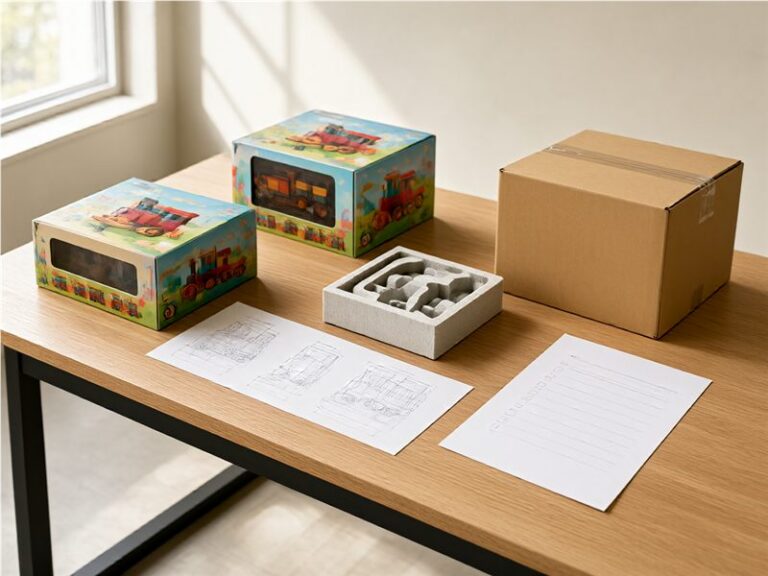
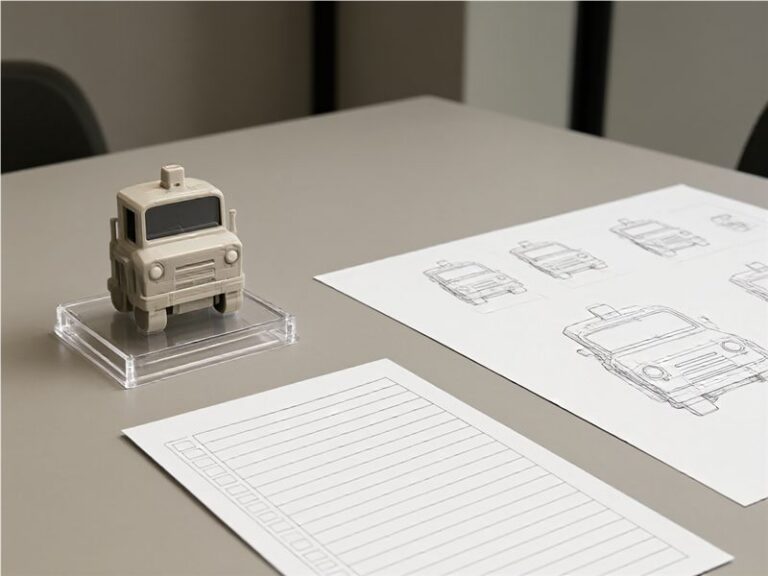
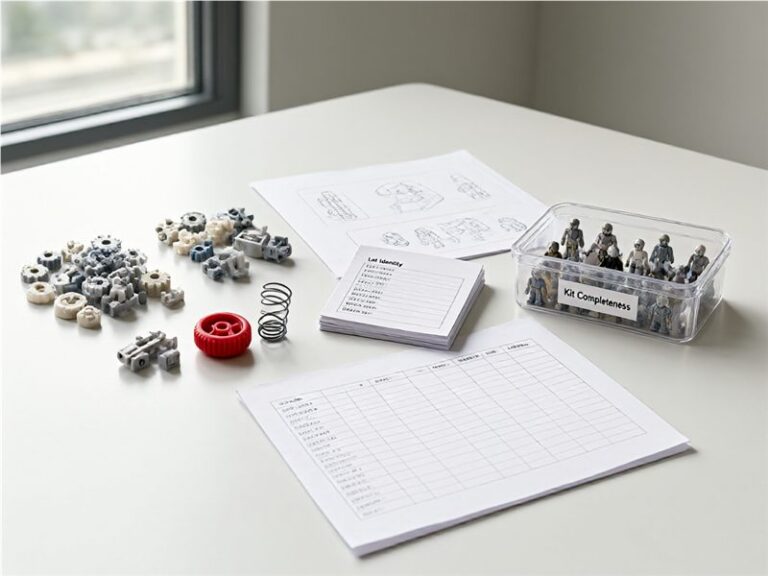
When a marketplace or customs officer asks why your toy is graded 6+, the answer has to come from a file, not from a feeling. Age grading is one of those claims that looks like a marketing decision and behaves like a document: it needs an intended-user statement, a play-pattern description, and design evidence that matches both. Skip the file and the label becomes an assertion — which is exactly what recalls are made of. The good news is that the whole file fits in one folder, and most of it already exists by the time the product is approved. The bad news is that it has to stay alive, and most companies let it die the week after launch.
The three documents that anchor the grade
First, the intended-user statement: who the toy is for, in one sentence, written before the artwork is approved — “children 6 and up who collect and swap fidget toys” is a statement, “ages 6+” alone is not. The sentence forces a decision about the play pattern, and the play pattern forces the hazard analysis that everything else leans on.
Second, the play-pattern description: how the toy is actually used — squeeze, assemble, launch, collect, throw, chew on the corner when nobody is watching. The use drives the small-parts exposure, the impact assessment and the foreseeable-abuse section of the test plan. A squeeze toy and an assembly kit with the same footprint have completely different hazard profiles, and a grade copied between them is a grade borrowed without the collateral.
Third, the design-feature record: small-parts cylinder measurements, sharp-edge and sharp-point assessments, cord and chain lengths, magnet flux index where applicable, and battery-compartment security if the toy is powered. Each line ties to a clause in EN 71-1 or ASTM F963, which is what makes the record auditable rather than anecdotal.
The file, as a checklist
Item
What it contains
Anchors to
Version rule
Intended-user statement
One sentence, dated, signed by brand
Label age icon
Re-date at every artwork revision
Play-pattern description
How the toy is used, 2–3 sentences
Hazard analysis
Update on any mechanism change
Design-feature record
Small parts, sharp edges, cords, magnets, batteries
EN 71-1 / ASTM F963 clauses
Tied to the released drawing number
Test report(s)
EN 71-1/2/3 and/or ASTM F963 with sub-clauses
Exact formulation and batch
Re-test on formulation change
Released label artwork
Age icon, warnings, tracking label
Print files
Photo of printed sheet per production date
None of these documents is exotic. Most exist in some form in a normal project — the statement is usually in the brief, the measurements are in the test report, the artwork is in the print files. The discipline is putting them in one folder, against the released drawing number, so the file answers as a unit instead of as an archaeology project.
What moves the grade
Grades move when the toy does. A rattle becomes a preschool toy when you add a figure; add small magnetic parts and the grade rises again, with a warning label to match; swap a hard-plastic antenna for a fabric one and the sharp-point line item disappears entirely. The grade is a function of the physical product, so every physical change is a grade question.
The classic failure we see at the factory is a buyer swapping a component after sign-off — a bigger bead here, a longer cord there — and reusing the old label because the artwork is already paid for. Nobody intended to cut a corner; the change felt cosmetic. But the small-parts cylinder does not care about intent, and neither does the marketplace compliance team that eventually measures the production sample.
EU and US: same idea, different paperwork
The logic is identical on both sides of the Atlantic, but the paperwork is not interchangeable. The EU runs on EN 71-1/2/3 with a CE mark and an EU responsible-person entry on the label; the DoC references the standards applied. The US runs on ASTM F963 under CPSIA with a children’s product certificate (CPC) and tracking labels that identify the production batch — the tracking label is the part most often missing from first-time importers’ artwork.
A grade defended by an EN 71 file says nothing to a US marketplace reviewer and vice versa. Dual-market listings need both files, and the label wording rules differ enough that the artwork should not be shared blindly between markets — the warning phrasing that satisfies one regulator can be non-standard for the other. If you are importing into both, budget for two label versions and two test tracks from the start; retrofitting the second market after the first launch costs more than planning it.
When the grade is challenged: the first 72 hours
Sooner or later a marketplace, an authority or a customer will question the grade. The first 72 hours decide whether it stays a question or becomes a case. What the file needs to produce in that window: the intended-user statement, the design-feature record showing the measurements behind the grade, the test report numbers paired to the exact formulation, and the released label artwork. If those four documents exist, dated and version-controlled, the challenge usually ends with an acknowledgment. If they exist in five mailboxes and a WhatsApp thread, it becomes an investigation.
The second-most-useful artifact is a photographed production sample next to the golden sample, taken at pre-shipment inspection. Photographs with dates prove what shipped; a file alone proves what was intended.
The label check at receipt
Even a correct file fails if the printed label drifts. Cartons from different production dates can carry different print versions — a supplier reorders label stock, a printer substitutes a font, an icon moves 3 mm and a warning line disappears — and nobody notices until a regulator or a reviewer does. Check the age icon and the wording against the released artwork at every receipt, not just the first one. One buyer we know keeps a photo of the approved label taped inside the QC clipboard; a low-tech habit, but it catches more mismatches than any clause in a purchase order.
Keep it alive
A file in a folder is a snapshot; a file that follows the product is a defense. Re-date the intended-user statement at every artwork revision, re-test on every formulation change, photograph the printed label sheet per production date, and store the whole set against the released drawing number. Digital folders work fine — the structure matters more than the medium: one folder per product, subfolders per revision, and a one-line changelog that says what changed and why.
If you are building a new toy line and want the grade decided during development rather than defended after it, our OEM manufacturing process documents age grading at the design stage, and the educational toy range shows how graded products are presented for retail.
Three failures we see, and what each one cost
The label drifted: two production dates of the same toy carried different age icons because a printer substituted a stock sheet. The fix was cheap; the marketplace delisting while the correction shipped was not.
The component changed: a buyer approved a larger bead for a better hand feel and reused the old label. The production sample measured differently in the small-parts cylinder, and the correction chain ran through the test lab, the artwork and the print house — six weeks for a decision that should have taken a day at the drawing stage.
The report expired: a formulation was tweaked for cost, the play feel was identical, and the test file no longer described the product inside the box. The grade survived; the file did not, and the next compliance audit asked for both.
Where the importer’s responsibility starts
The factory produces the evidence; the importer owns the grade. That division is not a courtesy, it is how the regulations read: the responsible party on the label is the one who answers for the grading decision, whichever entity actually ran the tests. In practice this means the importer reviews and signs the intended-user statement, confirms the play-pattern description against how their channel will market the toy, and keeps the file — not a copy buried in a supplier’s inbox. A factory that volunteers to “handle the documents” is offering to run your compliance, and the signature line still says your name.
Four questions buyers ask most
Does the age grade appear on the test report? The report references the tested sample and its features; the grade is your documented decision anchored to those features. Both live in the file.
Can one grade cover several colorways? If the colorways share the same mold, materials and label, yes — with the variant list recorded in the design-feature record.
What if two markets disagree on the grade? Follow the stricter one for the shared label, or split the artwork. The stricter grade always satisfies the looser one; never the reverse.
How long do we keep the file? For as long as the product is sold plus the statute window in your market — in practice, keep it while any unit is in the channel and archive it afterwards.
The one-page summary worth writing
Underneath every proper age-grading file, write a one-page summary in plain language: what the toy is, who it is for, why the grade is what it is, which reports back it, and when the last revision happened. The file is for auditors; the summary is for everyone else in your company who touches the listing, the artwork or the customer service inbox. Teams that maintain this page answer compliance questions before they become compliance tickets, because the person updating a listing can read one page instead of reverse-engineering a test report at midnight.
A worked example, start to finish
A clay activity set for 8+ makes the whole file concrete. The intended-user statement reads “children 8 and up who follow step-by-step build guides independently.” The play-pattern description covers opening sealed tubs, using plastic tools to shape and assemble, and air-drying the result over 24 hours. The design-feature record shows the tool edges pass the sharp-edge assessment, no small-parts issue at the 8+ threshold, and no cords. The EN 71-3 report pairs to the clay formulation revision in production. The released label carries the 8+ icon, the “not for children under 3” small-parts warning, and a tracking label with the batch code. One folder, five documents, all dated — and that set answered a marketplace query in under a day when a competitor’s listing was pulled for exactly this gap.
OEM & ODM TOY MANUFACTURING
Ready to Develop Your Custom Toy Line?
10+ years factory experience • EN71, ASTM F963 & CPC compliance support • Flexible MOQ for toy brands, importers, and Amazon sellers.