



Sensory sand looks like one of the simplest items in a toy catalogue: sand, a binder, a tub. In practice it is one of the easiest lines to get wrong on a bulk order, because the buying decision is spread across four different documents that rarely talk to each other — the material declaration, the age grading, the set configuration, and the packaging spec. Buyers who only negotiate on unit price end up with a product that performs beautifully in the sample tub and fails in a classroom, a sand table, or a retail shelf.
This guide walks through how to specify sensory sand and the tactile products that normally sit next to it on a planogram, using real specification data from a working sensory-toy factory catalogue. Every figure quoted below comes from an actual published product specification, not from a generic template, so you can use it as a sanity check when you read a supplier quote.
What “Sensory Sand” Actually Means in a Specification Sheet
The first thing to pin down is the material declaration. A credible sensory sand product will state two things separately: the base aggregate and the bonding agent. In the catalogue we are referencing, both the Sensory Space Sand set and the Soft Sensory Magic Sand declare Natural sand + non-toxic bonding agent as their material. That phrasing matters more than it looks. “Natural sand” tells you the aggregate is mined and graded rather than a synthetic polymer bead, and naming the binder as a bonding agent — rather than hiding it behind a marketing word — tells you the supplier is prepared to disclose what holds the grains together.
The performance claims that follow from that formulation are the ones buyers should test rather than trust. The published descriptions say the sand holds shapes without drying out, stays smooth and stretchy, never becomes sticky, and can be played with again and again without water or special storage. The mess-free claim is specific: the material sticks to itself, not to hands, clothes or carpets. Those are the four properties that determine whether a sand product gets reordered or returned, and they are all checkable in a fifteen-minute bench test on a sample.
It is worth separating the two product formats at this point, because they solve different retail problems. Sensory Space Sand is sold as a set that includes sand plus mould accessories, which makes it a self-contained play kit. Soft Sensory Magic Sand is a straight refill-style play sand with custom packaging as the OEM lever. If you are building a gift-leaning assortment, the set format carries the price point. If you are supplying sand tables, daycare centres or refill programmes, the bulk sand format is the one that matters.
Reading the Spec Sheet: Five Real Product Configurations
Below are five published configurations from the same factory catalogue, with the declared material, the declared age band, the declared use case and the listed unit price in USD. Treat the price column as an indicative published price for single-unit reference rather than a bulk quote — it is useful for seeing the relative distance between product types, which is what assortment planning actually runs on.
| Product | Declared material | Age | Declared use | Listed price (USD) |
|---|---|---|---|---|
| Sensory Space Sand | Natural sand + non-toxic bonding agent | 5+ | Sand + mould accessories set; sensory play, preschool learning, art therapy, sand tables, classroom activities | 2.99 |
| Soft Sensory Magic Sand | Natural sand + non-toxic bonding agent | 5+ | Sensory / educational play; indoor and outdoor | 1.31 |
| Silicone Sensory Stone | Silicone | All ages (children, adults, SEL settings) | Stress relief / fidget / social-emotional learning | 0.65 |
| Ultra Light Air Dry Clay | Air-dry clay | School projects / DIY art / party favours | Self-hardening in about 24 hours; paintable, carvable, sandable | 2.48 |
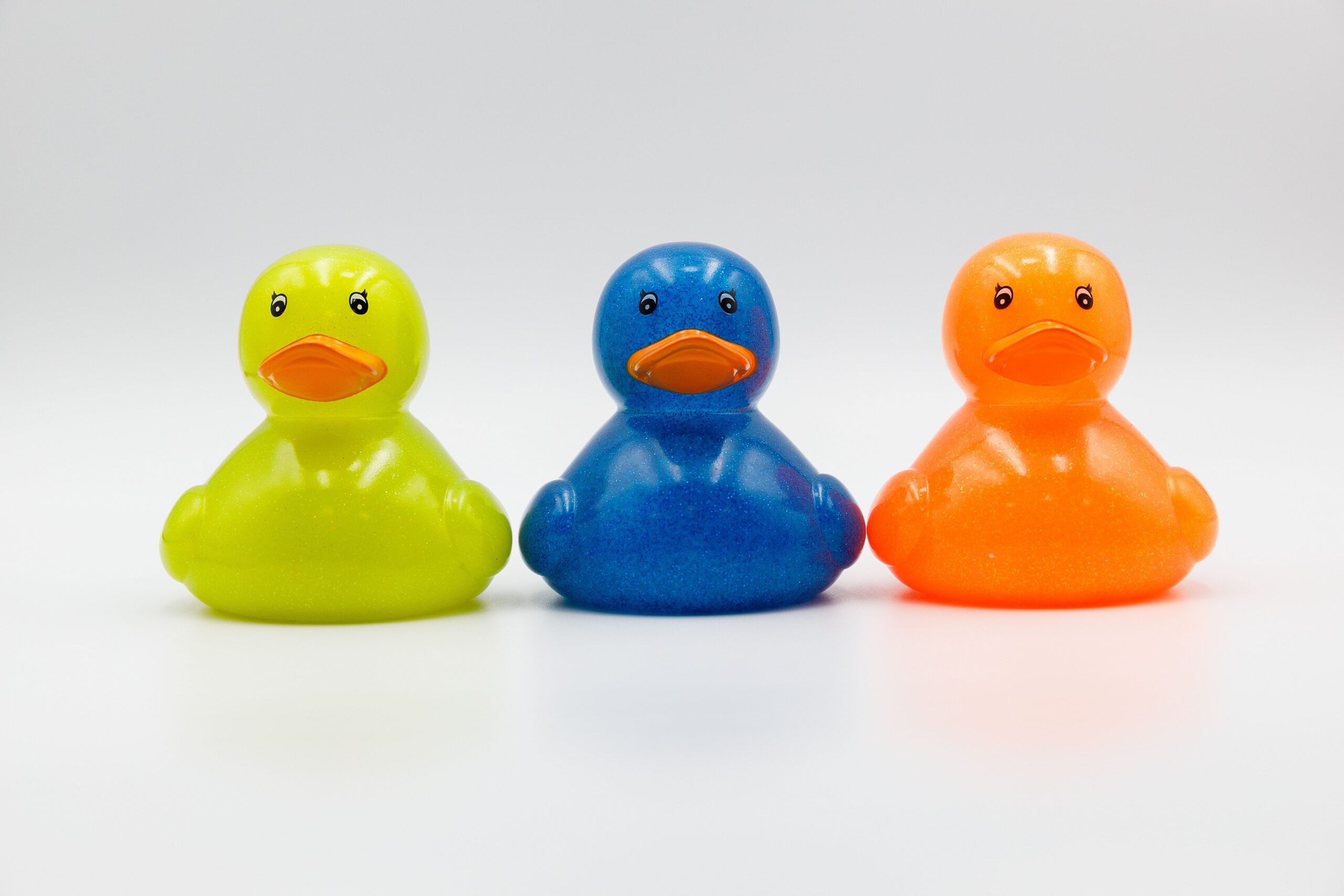
| Colorful Rubber Bath Ducks | Child-safe rubber | Toddlers and young children | Bath / pool / sensory play; floats, squeaks, squeeze | 0.31 |
Two observations from that table carry most of the buying insight. First, the price spread between the two sand products is roughly 2.3×, and the entire difference is set configuration — the material declaration is identical. If your margin model cannot absorb a mould set, buy the sand and source the moulds separately. Second, the cheapest item in the table is the one with the widest age band and the simplest material, which is a reminder that in sensory products price tracks complexity of assembly, not desirability.
Age Grading: Where the 5+ Line Comes From
Both sand products in this catalogue are declared 5+. Both are mouldable, non-drying, small-part-free materials intended for supervised sensory play. That same catalogue declares the rubber bath ducks for toddlers and young children, and the silicone sensory stone for all ages, explicitly naming children, adults and social-emotional learning environments.
There is a buying logic here that is easy to miss. Age grading in this category is driven by the physical form of the item, not by how “safe” the material is perceived to be. A loose, mouldable medium that a child can put in their mouth is graded for older children, even when the material is declared non-toxic; a single-piece silicone object sized for the palm is graded across all ages; a soft, floatable, single-piece rubber toy with no batteries and no assembly is graded down to toddlers. When a supplier quotes you a sand product at a younger age band than a comparable item in their own catalogue, that is a specification question worth asking, not a bonus.
Buyers should also note that the age band and the target channel are separate decisions. The published application list for the sand products runs from sensory play and preschool learning through art therapy, birthday parties, sand tables and classroom activities, with the named buyer groups being toy retailers, schools and educational suppliers. A product graded 5+ can still be sold into a therapy channel, and a product graded for toddlers can still be sold as a gift — but the labelling on the pack has to match the grading on the spec sheet in every market you ship to.
Packaging, Set Configuration and Shelf Format
Sensory sand is heavy for its volume, which makes packaging a logistics problem before it is a marketing problem. Three decisions drive landed cost:
- Set versus refill. The Space Sand set carries mould accessories, which adds volume, adds a second supplier input, and raises the unit price to 2.99 versus 1.31 for plain sand. Sets convert better in gifting; refills convert better in replenishment.
- Closure integrity. The core claim on both products is that the sand never dries out. That claim is only as good as the tub seal. A leak or a loose lid in transit converts a non-drying product into a hardened brick, and the failure surfaces at the customer, not at the factory.
- Custom packaging scope. The declared OEM/ODM line for Soft Sensory Magic Sand is custom packaging; for Sensory Space Sand it is custom set. Those are different commitments. Custom packaging means artwork and structure on an existing fill; custom set means the contents themselves can be re-specified.
The factory states that both sand products support bulk orders with custom colours, sets and packaging, and names toy retailers, schools and educational suppliers as the intended customers. If you are planning a private-label launch, agree the artwork, the tub, the seal and the fill weight in one document, and ask for a production sample from the actual mould and the actual lid — not a hand-assembled prototype.
Building a Tactile Assortment Around Sand
Sand rarely sells alone. In a sensory aisle it sits next to clay, fidget objects and water toys, and the way those items are specified determines whether the whole bay holds together. Here is how the adjacent items in this catalogue are declared:
| Adjacent item | Declared specification | Why it sits next to sand |
|---|---|---|
| Silicone Sensory Stone | Silicone; palm-sized with textured surface; stress relief / fidget / SEL; cleans with soap and water; custom shape and colour | Quiet, portable, no residue — the “calm” counterweight to messy play; used in classroom calm-down corners, therapy sessions and travel |
| Ultra Light Air Dry Clay | Air-dry clay; self-hardens in about 24 hours; no oven or kiln; can be painted, carved or sanded after drying; custom colour and packaging | The make-and-keep item: same tactile channel, but produces a permanent object, which lifts perceived value |
| OEM/ODM Air Dry Clay Play Dough | Air-dry clay; about 24 hours; soft, lightweight, odourless, non-toxic and eco-friendly; will not crack while modelling; custom colour and packaging | The private-label entry point — listed at 0.71, it is the lowest-cost modelling SKU in the catalogue |
| Colorful Rubber Bath Ducks | Child-safe rubber; floats, squeaks, squeezes; no batteries or assembly; custom logo, shape and colour | Extends the sensory story into water play and the toddler age band, where sand cannot go |
Notice the material logic across the bay. The sand products are loose media; the silicone stone and the rubber ducks are single-piece objects; the two clay products are formable media that cure. A balanced sensory assortment carries one item from each of those three behaviours, because they produce different play patterns and different repeat-purchase cycles. A bay built entirely from loose media competes with itself on price; a bay built entirely from single-piece objects has no consumable to drive replenishment.
OEM/ODM, Private Label and the Pre-Production Checklist
Every product referenced here declares OEM/ODM availability, but the declared scope differs and that difference is where most first orders go sideways. The scopes published in this catalogue are:
- Sensory Space Sand — available as a custom set
- Soft Sensory Magic Sand — available with custom packaging
- Silicone Sensory Stone — custom shape and colour, plus logo printing
- Ultra Light Air Dry Clay — custom colour, private label and packaging
- OEM/ODM Air Dry Clay Play Dough — custom colour, private label and packaging
- Colorful Rubber Bath Ducks — custom logo, shape and colour
Before you release a bulk order, work through the following checklist. It is deliberately unglamorous; each item corresponds to a failure mode that shows up after the container ships.
- Confirm the material declaration in writing on the pro-forma invoice, not just in the catalogue. “Natural sand + non-toxic bonding agent” should appear as a line item.
- Confirm the age grading matches your market labelling, and that the printed pack matches the grading on the spec sheet.
- Request a production sample made with the final mould, final lid and final binder batch, then leave it open on a bench for a week and check the non-drying claim yourself.
- Test the mess-free claim on carpet, because that is the claim parents and teachers actually repeat.
- Agree the custom scope explicitly. Custom colour is not custom set; custom packaging is not private label. Name which of the four you are buying.
- Specify the buyer channel, because the factory tailors to toy retailers, schools and educational suppliers differently — and that affects fill weight and pack count more than it affects the material.
Frequently Asked Questions
Is sensory sand the same product as kinetic sand or magic sand?
In the catalogue referenced here, the two sand products are declared with the same material — natural sand plus a non-toxic bonding agent — but sold in different configurations. “Soft Sensory Magic Sand” is the plain play sand at a listed price of 1.31; “Sensory Space Sand” is a set with mould accessories at 2.99. The material is the same, the format is not, and the format is what you are pricing.
Why is the sand graded 5+ while the rubber ducks are graded for toddlers?
The grading follows the physical form. A loose, mouldable medium carries a higher age band than a single-piece soft rubber toy with no batteries and no assembly. Both declarations appear in the same factory catalogue, which is a useful internal consistency check when you review a new supplier’s age claims.
Does the sand really never dry out?
That is the published claim for both sand products, along with the statement that no water or special storage is needed. The honest answer for a buyer is that the claim depends on the container seal as much as on the formulation, so verify it on a production sample with the final lid rather than on a loose sample bag.
What is the cheapest way to start a private-label sensory line?
On published prices in this catalogue, the lowest entry points are the rubber bath ducks at 0.31, the silicone sensory stone at 0.65 and the OEM/ODM air-dry clay play dough at 0.71. All three declare customisation scope, so all three can carry your brand without a tooling conversation.
Which channels are these products built for?
The stated buyer groups are toy retailers, schools and educational suppliers for the sand and clay lines, and baby product brands, gift suppliers and wholesalers for the rubber ducks. The silicone sensory stone is aimed at schools, therapists, retailers and wellness brands. Pick your channel before you pick your pack, because fill weight and pack count follow the channel.
Conclusion
Specifying sensory sand well is mostly a matter of refusing to let four separate decisions collapse into one price negotiation. The material declaration tells you what you are buying; the age grading tells you who you can sell it to; the set configuration tells you what it costs to land; the custom scope tells you how much of it can carry your brand. The catalogue data quoted above shows how wide the spread really is — identical materials at 1.31 and 2.99 depending purely on set configuration, and a five-fold price range across the tactile bay from 0.31 to 2.99.
Buyers who write all four decisions into a single purchase specification, then verify the non-drying and mess-free claims on a production sample, will find that sensory sand is one of the more predictable lines in the category. Buyers who only negotiate the unit price will find out what went wrong when the first classroom opens the tub.