


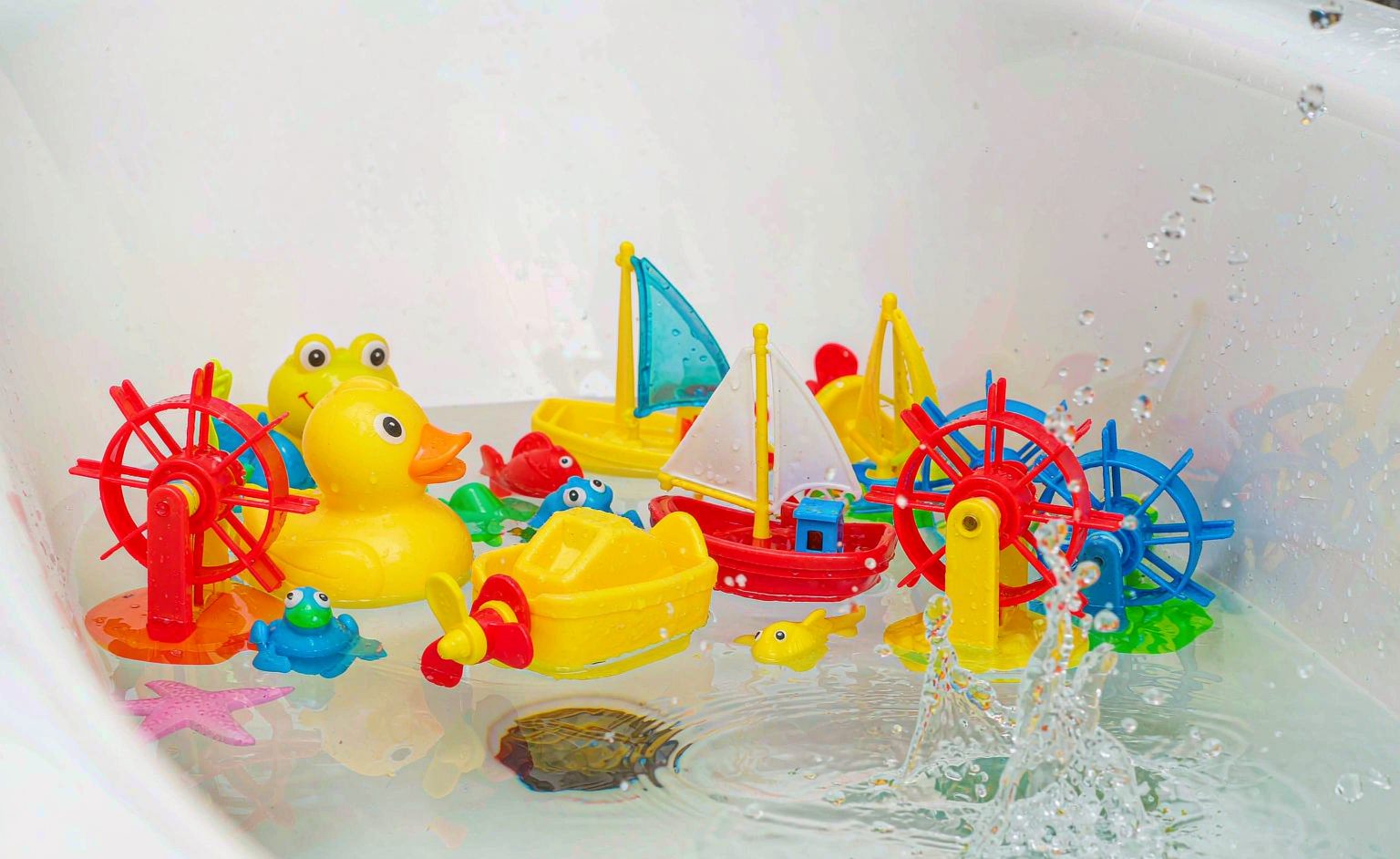
Bath toys fail in ways other toys do not. They sit in warm, wet, enclosed environments; they retain water in cavities that never dry; and they are squeezed, sucked and dropped on hard tile. A bath toy that is delightful in the showroom grows mould in the third week and generates the review that kills the listing. This guide covers the specification decisions that separate a durable bath toy from a disposable one.
Principales conclusiones
- Mould resistance is a design outcome, not an additive — it comes from drainability and drying.
- Hole-free construction is safer but traps water; drainable design is the alternative.
- Material choice drives both cost and mould behaviour; silicone drains and dries best.
- Mould cost is driven by part complexity and cavity count, not by toy size.
- Suction, floatation and squeeze behaviour are specification fields, not accidents.
The Mould Problem Is a Design Problem
Mould in a bath toy is almost always a consequence of trapped water, and trapped water is a consequence of geometry.
| Design factor | Effect on mould risk | What to specify |
|---|---|---|
| Enclosed cavities | Water enters and cannot escape | Drain holes or fully sealed construction |
| Seam and joint design | Creases hold water and biofilm | Smooth, minimal seams |
| Surface texture | Rough surfaces retain biofilm | Smooth finish specification |
| Material porosity | Porous materials harbour growth | Non-porous material specification |
The honest framing for buyers: an antimicrobial additive helps marginally, but the decisive variable is whether the toy drains and dries. A toy that cannot be emptied will eventually grow something regardless of what is in the material. The growth mechanism is described in mould references.
Hole-Free Versus Drainable Design
This is the central design trade-off in bath toys, and it has a safety dimension.
| Design | Advantage | Disadvantage |
|---|---|---|
| Hole-free (fully sealed) | No water ingress; no squeeze-out jet; safer for young children | Cannot be drained; must be designed to dry externally |
| Drainable (with holes) | Empties and dries; interactive water play | Water ingress; squeeze-out is a hazard for the youngest ages |
| Hybrid (sealed body, drainable base) | Balances both | More complex tooling |
For the youngest age bands, hole-free construction is usually the right specification, because squeeze-out water is both a slipping hazard and a hygiene issue. If holes are required for the play pattern, place them where the toy can be fully inverted and drained. The age-grading and safety requirements are covered in our water-play specification guide.
Material Choice
Material drives cost, feel, and how the toy behaves in warm water.
| Material | Bath-toy behaviour | Cost position |
|---|---|---|
| Silicona | Non-porous, heat stable, dries well, soft feel | Highest material and tooling cost |
| TPR | Soft and inexpensive; porosity depends on grade | Lowest cost; common default |
| EVA foam | Light, floats, inexpensive | Low cost; absorbs water and dries slowly |
EVA deserves a caution: it floats well and costs little, but it absorbs water and dries slowly, which makes it the highest mould-risk material in the category. Specify a fast-drying grade or avoid enclosed foam construction. The material comparison across the wider category is in our sensory toy materials comparison, and the elastomer properties in silicone elastomer references.
Mould Cost and MOQ
Tooling is the largest single line in a custom bath-toy program, and its drivers are specific.
| Driver | Effect on mould cost | Buyer lever |
|---|---|---|
| Part complexity | Undercuts, appendages, internal features | Simplify geometry where play allows |
| Cavity count | Near-linear with the number of cavities | Match cavitation to real volume |
| Slide and action count | Each action adds design and machining | Design out side actions where possible |
| Surface finish | Polishing and texture add steps | Limit the number of distinct finishes |
The practical guidance: cavity count should match volume, not ambition, because a four-cavity tool for a low-volume SKU buys machine-time savings you will never collect. The MOQ structure behind these drivers is covered in our sensory set specification guide, and the compliance scope in nuestra guía de certificación de juguetes.
Preguntas Frecuentes
¿Qué hace que un juguete de baño resista el moho?
Drainability and drying, not additives. A toy with enclosed cavities that cannot be emptied will eventually grow something regardless of what is in the material.
¿Deben tener agujeros los juguetes de baño?
For the youngest age bands, usually no — hole-free construction avoids squeeze-out water and ingress. Where holes are needed for the play pattern, place them so the toy can be fully inverted and drained.
Which material is best for bath toys?
Silicone is non-porous, heat stable and dries well, at the highest cost. TPR is the low-cost default. EVA floats cheaply but absorbs water and dries slowly, making it the highest mould risk.
What drives bath toy mould cost?
Part complexity and cavity count, more than toy size. Undercuts, appendages and slide actions each add design, machining and fitting work.
How many cavities should a bath toy tool have?
Enough to serve your volume without paying for idle capacity. A multi-cavity tool for a low-volume SKU buys savings you will never collect.
What should I specify besides material and shape?
Surface finish, seam quality, floatation behaviour, suction behaviour where applicable, and the drying requirement. All are specification fields, not accidents.
Does a bath toy need separate testing?
It needs the standard toy testing, and the material and any additives must be in scope. Water exposure is a use condition, not a separate standard, but it drives the material specification.
Antecedentes técnicos: bath toys, mould growth y silicone elastomers explain the product category and the material behaviour referenced above.