



Water is the most demanding environment a children’s product will ever meet. A toy that performs perfectly on a classroom table can fail within weeks once it is dropped into a bath, left floating in a paddling pool, or rinsed under a tap and tossed wet into a toy bin. For buyers building a sensory or early-childhood range, this matters because the water-play segment is not a seasonal add-on — it is a repeat-purchase category with its own material rules, its own failure modes and its own set of questions that a supplier must be able to answer in writing before a purchase order is signed.
This guide is written for brand owners, importers and retail program managers who are specifying bath and water-play items for bulk orders. Rather than repeating generic advice, it works from real specification data taken from live product pages at Jiteng — the Pato de goma de bañera colorido, the Piedra Sensorial de Silicona and the Arcilla Aire Seco Ultraligera — and shows how to read those specifications the way a sourcing engineer reads them. Every figure quoted here comes from those pages. Where a specification is silent on something, this guide says so explicitly, because a gap on a spec sheet is itself a piece of information you should act on.
What “Water-Play” Actually Demands From a Material
Before comparing products, it helps to separate the four stresses that any water-exposed toy has to survive. The first is continuous immersion: the item sits in water for ten to thirty minutes at a time, repeatedly, for months. The second is wet-dry cycling: it soaks, then dries, then soaks again, and anything that absorbs water will change dimension or grow residue at the seams. The third is cleaning chemistry: parents use soap, bubble bath, shampoo and sometimes diluted bleach, and the material has to tolerate repeated contact without becoming tacky or chalky. The fourth is mechanical handling while wet: wet hands and wet plastic are a low-friction combination, so items get dropped, squeezed harder than intended and stepped on.
Different materials solve these four problems in different ways. A closed-cell or non-porous material simply does not take up water, which removes most of the wet-dry cycling risk at a stroke. A porous or water-soluble material cannot be used in the bath at all, no matter how attractive its tactile properties are. This single distinction — porous versus non-porous — is the dividing line that should structure your product line, and it is worth making it an explicit column in your internal sourcing matrix rather than something you discover during a customer complaint.
It also explains why the water-play category is unusually sensitive to honesty in specification. A buyer who orders a dry sensory material and markets it as a bath toy has not made a marketing mistake; they have created a product that will physically disintegrate in the hands of a child. Reading the “Use” field on a supplier’s specification table before writing your own listing copy is the cheapest risk control available to you.
Rubber Bath Ducks: What the Spec Sheet Really Tells You
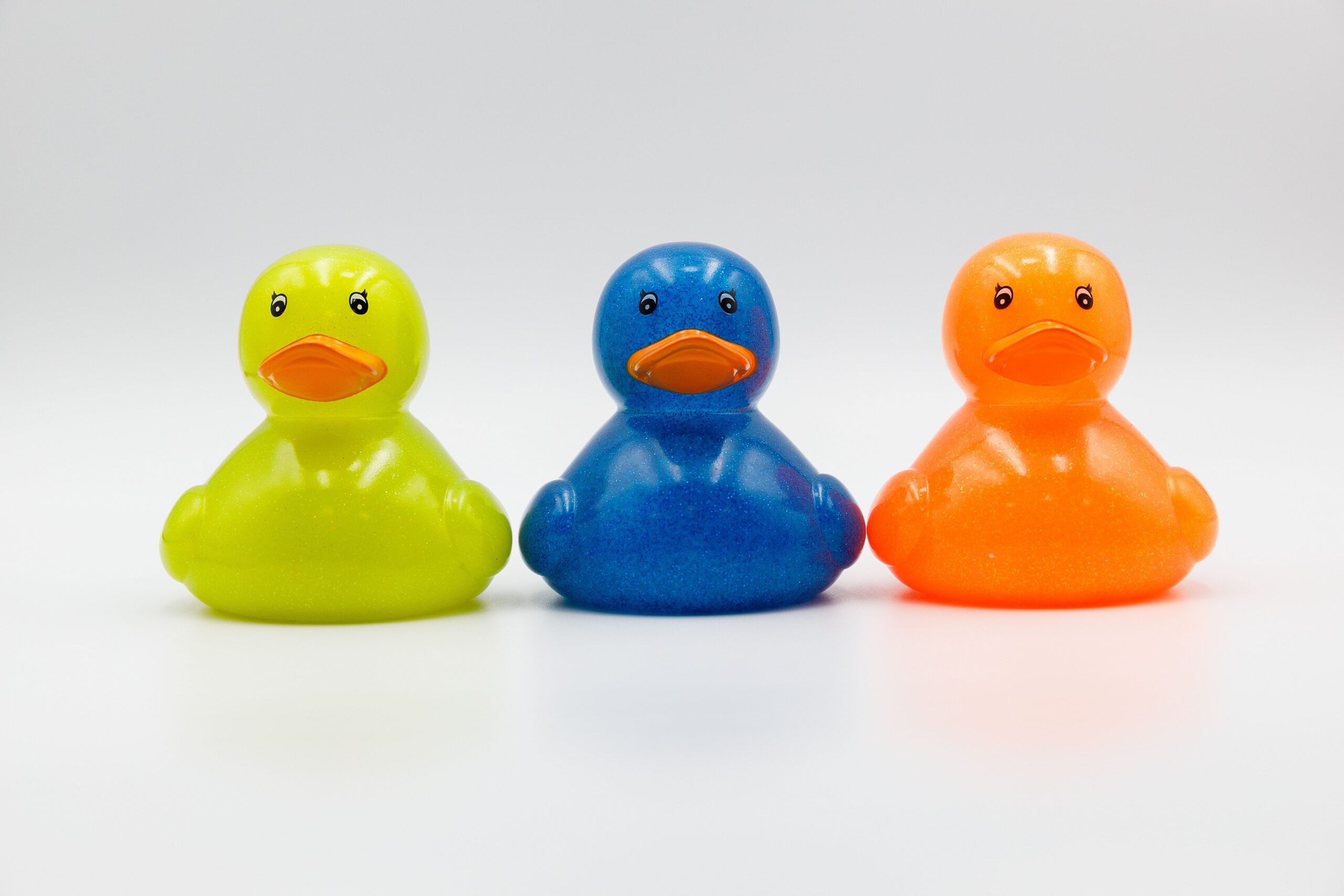
The rubber bath duck is the reference product of this category, and Jiteng’s version is a useful worked example. The specification table lists the material as child-safe rubber, the intended use as “Bath / Pool / Sensory Play”, and the target age as toddlers and young children. The feature list adds four properties: non-toxic and durable, a soft squeeze with a gentle squeak, bright colours and fun shapes, and the ability to float and squeak in water. OEM/ODM is available with custom logo and colour.
Read as an engineer rather than a shopper, each of those lines carries a requirement. “Floats” is not decoration — it means the finished part must have positive buoyancy including the weight of any squeaker assembly fitted inside it, and it must keep that buoyancy after the moulding flash is trimmed. In practice this makes the squeaker the critical component: it is the densest part of the assembly, it is enclosed, and it is the part most likely to trap water if the seal is imperfect. When you qualify a bath-duck supplier, ask specifically how the squeaker is seated and sealed, and ask for the immersion test method, because that is where the field failures come from.
“Soft squeeze” is the second hidden requirement. A duck that is too soft will collapse when a toddler grips it and fail to rebound, which reads to the parent as cheap. One that is too firm is unpleasant to squeeze and, for the youngest age group, harder to hold with wet hands. This is a durometer specification, and it is the single most useful number you can request from a factory. If a supplier cannot quote a hardness value, that is not a reason to reject them, but it is a reason to order a larger pre-production sample and compare it against a reference item you already like.
The third point is the one most buyers miss: the specification explicitly includes “Sensory Play” alongside bath and pool. A product positioned this way is being sold into two different retail conversations. In the bath aisle the selling point is fun and buoyancy; in the sensory or early-development aisle the selling point is tactile engagement and graspability. Same product, two listings, two sets of imagery, and — importantly — two different price points. Jiteng’s listed unit price for this item is 0.31, which places it firmly in the impulse and gift-with-purchase band rather than the premium educational band. That price tells you where the product is designed to sit, and you should plan your packaging spend accordingly.
Silicone in the Water and Out of It: One Material, Two Programs
Silicone is the other workhorse of the water-play category, and Jiteng’s Silicone Sensory Stone shows how a single material can serve two very different programs. The specification lists the material as silicone, the use as “Stress relief / Fidget / SEL”, and the cleaning method as “Rinse with soap and water”. The applications listed are classroom calm-down corners, office stress relief, therapy sessions, travel and daily mindfulness practice. Customisation covers shape, colour and logo printing.
The cleaning line is the one to pay attention to. “Rinse with soap and water” is not a throwaway instruction — it is a statement that the surface is non-porous and chemically tolerant enough for routine washing, which is exactly the property that makes silicone viable in wet environments and in shared settings such as classrooms and therapy clinics. A material that requires wiping with a dry cloth cannot be deployed in a calm-down corner used by twenty children a day; silicone can. If you are building a range for institutional buyers, this single line on the spec sheet is often the difference between a product that passes a procurement review and one that does not.
The second observation is that this item is priced at 0.65 — roughly twice the bath duck — while doing less mechanical work. There is no squeaker, no buoyancy requirement and no moving assembly. What the buyer is paying for is the material itself and the textured surface, and the texture is the actual product. When you brief a factory on a silicone item, the texture pattern is the specification that deserves the most attention: it is the feature the customer touches, it is what photographs well, and it is what a competitor cannot copy from a catalogue image. Ask for a physical texture swatch before you approve tooling.
There is also a strategic point here about portfolio construction. Because the same silicone item appears in a wellness program and in a special-education program, and because silicone tolerates water while air-dry materials do not, a buyer can build a coherent “washable” sub-range that spans both categories. That sub-range is easier to merchandise, easier to explain to a retail buyer, and far easier to defend on a safety questionnaire than a mixed bag of materials with different cleaning rules.
Where Dry Sensory Materials Stop and Water Starts
The third product in this comparison is deliberately the odd one out. Jiteng’s Ultra Light Air Dry Clay is described as ultra light and soft, non-toxic and kid-safe, and self-hardening in about 24 hours with no oven or kiln needed. It can be painted, carved or sanded after drying, its listed use is school projects, DIY art and party favors, and it supports custom colours, private label and packaging. At 2.48 per unit it is the most expensive item discussed here.
Notice what is absent: there is no bath, no pool and no cleaning instruction in the specification. That absence is the point. Air-dry clay hardens by losing water to the atmosphere, which means water is not its play environment — it is its curing mechanism. Put it in a bath and you do not get a messy bath, you get no product at all. This is why the “Use” field on a specification table deserves more respect than it usually gets: “School projects / DIY art / party favors” is a boundary, not a suggestion.
The same logic applies to Jiteng’s sand products. Sensory space sand is listed at 2.99 and built from natural sand with a non-toxic bonding agent, aimed at ages 5 and up and supplied with sand and mould accessories; soft sensory magic sand uses the same material family with custom packaging and is listed at 1.31. Bonded sand is engineered to hold a shape when pressed and to release it when worked — a behaviour that depends on the material staying dry. These are table products, and they are excellent table products, but they sit on the opposite side of the porous/non-porous line from rubber and silicone.
For a buyer, the practical output of this section is a simple rule you can apply to any catalogue: if the spec sheet names water, pool or rinsing as a use or cleaning method, the product belongs in the water-play line; if it names drying, hardening or air cure, it belongs in the dry line and should never be photographed in a bath. Crossing that line in your marketing imagery is how a good product acquires a bad review.
The Price Ladder: What 0.31 to 2.99 Actually Buys
Prices across this small sample span almost an order of magnitude, and the spread is instructive because it does not track complexity in the way most buyers assume.
| Producto | Material | Listed use | Cleaning / curing | Unit price |
|---|---|---|---|---|
| Pato de goma de bañera colorido | Goma segura para niños | Baño / Piscina / Juego sensorial | Non-porous, wipe or rinse | 0.31 |
| Piedra Sensorial de Silicona | Silicona | Stress relief / Fidget / SEL | Rinse with soap and water | 0.65 |
| Arena mágica sensorial suave | Arena natural + agente de unión no tóxico | Sensory play | Air cure — keep dry | 1.31 |
| Arcilla Aire Seco Ultraligera | Arcilla de secado al aire | Proyectos escolares / Arte de bricolaje / Detalles para fiestas | Air dry, self-hardens ~24h | 2.48 |
| Arena sensorial | Arena natural + agente de unión no tóxico | Sensory play, ages 5+ | Air cure — keep dry | 2.99 |
The cheapest item is the one with the most engineering in it: a hollow floatable body with a sealed sound component inside. The most expensive items are the ones with no mechanism at all. What changes across the ladder is not manufacturing difficulty but material cost per unit of play value and the packaging context the product is sold into. Sand and clay are sold as activity sets, where the buyer is paying for volume of material, moulds, accessories and a box that looks substantial on a shelf. A duck is sold as a single unit, often into a gift or party-favour channel where the landed cost has to clear a very low retail price.
There is a second pattern worth noticing. The two sand products share a material family and differ by more than a factor of two in price, with the difference attributed to packaging and accessories. That is a clear signal that in the dry sensory category, packaging is a primary cost driver rather than a finishing detail. If you are negotiating on a sand or clay program, the lever with the most room in it is usually the accessory pack and the box, not the material.
The practical conclusion for range planning is that you should not expect a single margin model to work across both halves of this ladder. Water-play items compete on unit cost and durability; dry sensory items compete on presentation and completeness. Treating them as one category with one target margin is the most common planning error in this segment.
Packaging, Labelling and the Questions to Ask Before You Sign
Because these products are aimed at toddlers and young children, and because two of the three are explicitly used in institutional settings, the documentation question deserves a section of its own rather than a footnote. A specification that says “non-toxic” is a claim, and a claim is only as useful as the test report behind it. Jiteng’s pages state non-toxic materials and child-safe rubber, which is the right starting position, but the buyer’s job is to convert that statement into paperwork: ask which standard the claim was tested against, for which age grade, in which laboratory, and with what report date. If the answer is that the material is non-toxic by formulation rather than by test, that is still an answer — it just tells you that you need to budget for your own testing before you list the product in a regulated market.
The second question is about the squeaker assembly on float toys. It is an enclosed component inside a product used by the youngest age group, and it is the part most likely to fail. Ask how it is retained, whether it is removable, and what happens to buoyancy if water enters the cavity. A supplier who has thought about this will have a test method; a supplier who has not will change the subject.
The third question is about cleaning instructions on the retail pack. Silicone items can carry “rinse with soap and water” and it will be true; a duck can carry it too. But the moment a set mixes a washable item with a dry-only material such as air-dry clay or bonded sand, the pack needs two different care statements, and getting that wrong generates returns. Write the care text from the specification table, not from the photo shoot.
Finally, plan the OEM conversation early. Jiteng lists custom logo, shape and colour for the ducks; custom shape, colour and logo printing for the silicone stone; and custom colours, private label and packaging for the clay. Those are three different customisation menus, and they map onto three different tooling conversations. Knowing which menu applies to which item before you open negotiations will save you a full round of clarification emails.
Preguntas Frecuentes
Can air-dry clay or sensory sand be used as a bath toy?
No. Air-dry clay cures by losing moisture to the air and self-hardens in about 24 hours, and bonded sand is engineered to hold a pressed shape only while dry. Both are specified for table use. For water environments, use non-porous materials such as the child-safe rubber used in bath ducks or the silicone used in sensory stones.
What makes a bath duck float, and what makes it stop floating?
Buoyancy comes from the enclosed air volume of the hollow body, and it is lost when water enters that cavity — most often through an imperfectly sealed squeaker assembly. This is why the squeaker, not the rubber, is the component to question during supplier qualification.
Why is a simple silicone stone priced higher than a bath duck with a squeaker in it?
Because the two products are priced against different channels rather than different manufacturing difficulty. The duck is an impulse or party-favour item competing on unit cost; the silicone stone is sold into wellness, classroom and therapy programs where the material, the texture and the washability carry the value. The listed prices of 0.31 and 0.65 reflect those channels, not the engineering.
How should silicone sensory items be cleaned in a classroom or clinic?
The specified method is to rinse with soap and water. That instruction is worth reproducing on your retail pack, because it is the property that makes the item viable in shared settings where it is handled by many people each day.
What should I ask for if a supplier says a material is “non-toxic”?
Ask which standard it was tested against, for what age grade, by which laboratory and on what date. A formulation-based claim is not worthless, but it means you should budget for independent testing before listing in a regulated market rather than assuming compliance is already documented.
Conclusion
Specifying a water-play line is mostly an exercise in respecting one boundary. On one side sit non-porous materials — the child-safe rubber of a bath duck and the silicone of a sensory stone — that tolerate immersion, survive wet-dry cycling and can be rinsed with soap and water. On the other side sit materials defined by drying and curing, such as ultra-light air-dry clay and bonded sensory sand, which are excellent products that simply do not belong in a bath. Most product failures in this category are not material failures; they are specification failures, where a good dry product was merchandised into a wet environment.
Once that boundary is drawn, the rest of the sourcing work becomes straightforward. Qualify the squeaker rather than the rubber on float toys. Treat texture as the specification on silicone items. Read the price ladder as a channel signal rather than a complexity signal, and negotiate packaging hardest on the dry sensory sets where packaging is the cost driver. Then convert every “non-toxic” claim into a dated test report before the goods ship. Do that, and the water-play range you build will be the one that comes back for a repeat order instead of a complaint.